


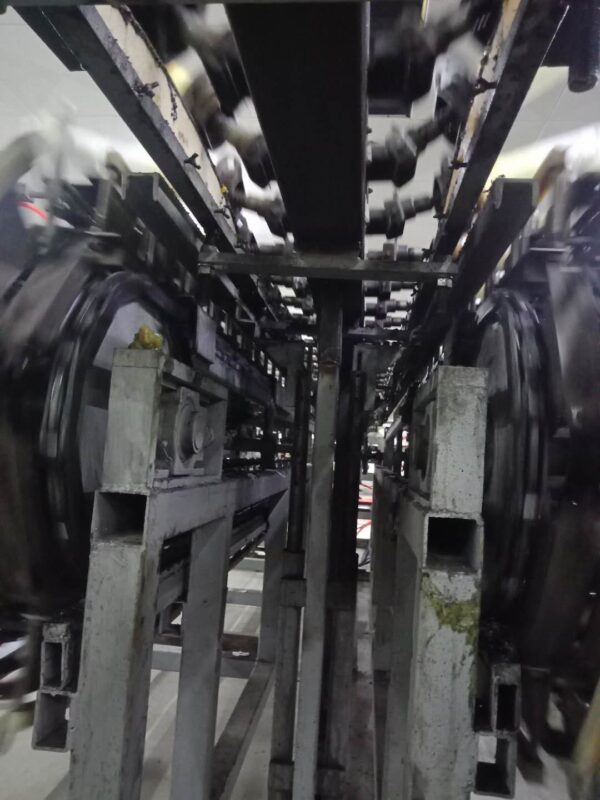
1. Precise Synchronization Function
Hundreds or even thousands of molds on a glove production line must achieve millimeter-level synchronization across dozens of workstations, including dipping, cuff rolling, drying, demolding, and packaging. Inadequate speed uniformity or synchronization accuracy can lead to uneven glove thickness, inconsistent cuff rolling, or demolding failures. The transmission system ensures the synchronized movement of all molds.
Key components of the transmission system include: gear rack systems or synchronous belts, precision reducers, high-accuracy servo motors, and closed-loop encoders.
2. Precise Speed Variation Function
The glove production process is not uniform in speed: molds must move slowly and smoothly when dipping into and lifting out of the latex tank to prevent air bubbles or latex dripping. During transport in the drying oven, a constant speed must be maintained, while a brief pause or slight movement is required during glove demolding.
Key components of the transmission system include: specialized motion controllers or PLCs programmed to achieve complex speed curves (S-curve acceleration and deceleration), ensuring smooth operation without shocks or vibration.
3. High Cleanliness and Corrosion Resistance
The transmission system components must be corrosion-resistant, dust-proof, and easy to clean, as they come into contact with chemicals such as glove solutions, additives, and disinfectants during production. This can be achieved by using stainless steel rails, bearings, and chains; motors and drives with high sealing protection ratings (e.g., IP65 or above); food-grade lubricants; and designs that avoid grooves where dirt can accumulate.
4. Minimal Vibration and Noise
Vibration during glove production can cause mold vibration, which in turn affects the quality of dipping and cuff rolling. To address this, it is essential to adopt a high-strength, high-rigidity frame structure, use maintenance-free polymer mute rails and low-noise synchronous belts, and perform fine dynamic balancing corrections on the drive system.
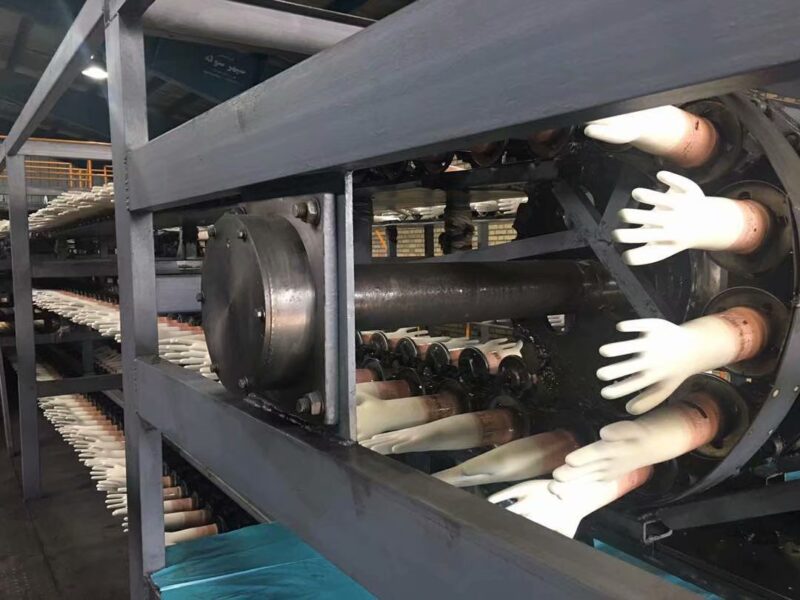
ملخص
When selecting or evaluating a production line, the transmission system should be a core focus. A thorough analysis of its technical solutions, key component brands, and actual operational data is crucial, as these factors directly determine the production line’s technical level, return on investment, and long-term competitiveness.
Speed and Capacity: The maximum linear speed (meters/minute) and acceleration capability directly determine single-line production capacity. The analysis should focus on long-term stability at the maximum design speed.
Overall Equipment Effectiveness (OEE): The stability of the transmission system is key to OEE. Factors such as fault-induced shutdown, speed loss (e.g., due to forced speed reduction caused by vibration), and quality defects (e.g., defective products due to synchronization issues) are directly influenced by the transmission system.

 Arabic
  English
  Hindi
Hindi  Tamil
Tamil  Thai
Thai  Malay
Malay