


A client wants to build a glove factory and has asked us how to lay out the production line. Many factors influence glove production line layout, and the layout directly determines capacity, yield rate, and flexibility for future product changeovers. Attention should be paid to the line length and the number of gloves to be produced, as well as to matching the backend processes—curling, demolding, packaging, and so on—to ensure a high yield rate. The following outlines the underlying logic of glove production line layout across four dimensions: production process, sizes, investment cost, and floor space
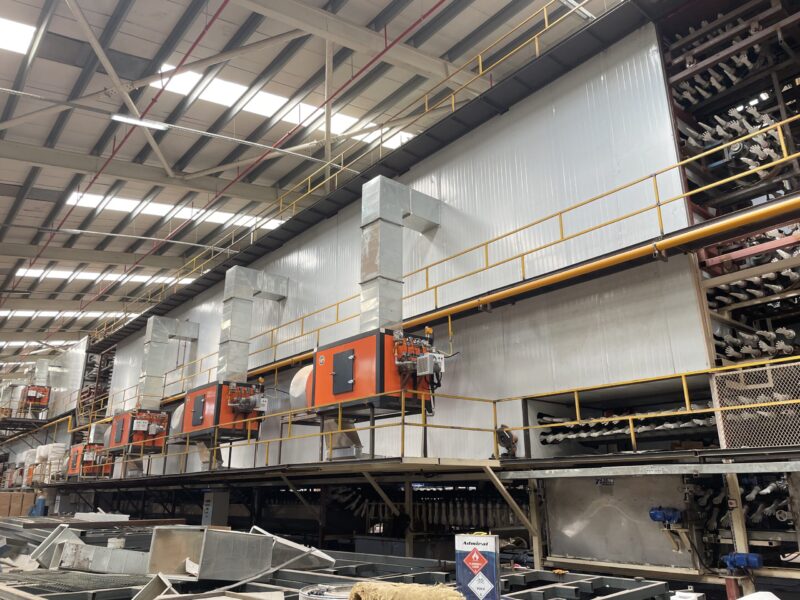
1. Determine line length and target capacity
Characteristics of small-scale lines: fewer hand molds, lower capacity, compact spacing between stations such as curling and demolding—suitable for single-variety production.
Characteristics of large-scale long lines: more hand molds, higher capacity, long vulcanization ovens; the speed of the entire line is set by the slowest station—no matter how fast the front end runs, if the downstream curling and demolding can’t keep up, bottlenecks will occur.
2. Size configuration (key reminder)
Li Jianqiang, general manager of फेंगवांग, says: customers always want to produce more sizes, but note that the more sizes there are, the more varied the hand mold specifications become, and the less adaptable the backend curling machines and demolding machines are—leading to uneven curling and mold jamming during demolding, which directly drives up the defect rate. It is generally recommended to produce no more than 2 sizes on one line—don’t pile too many sizes onto a single line. It’s better to run an additional line to achieve a better yield rate.
3. Equipment investment, plant area, energy consumption, routine maintenance, labor costs, etc. should be evaluated on a lifecycle basis rather than looking only at the equipment price quote.
4. The layout drawing should show: the hand mold flow process, the supply of glove latex, coagulant, and end-of-line packaging, the separation of finished and defective products, the capability for multiple varieties to share a line, reserved space for future expansion and upgrades, and space for oven cleaning.
So production line layout is really about finding a balance among the glove production process, sizes, investment cost, floor space, and other factors. Be careful at the layout stage, and you’ll avoid pitfalls during production startup. If you are planning to build a glove factory, welcome to contact us—we can help you develop a layout solution that better suits your needs.

 Hindi
 English
 Arabic
 Tamil
 Thai
 Malay