


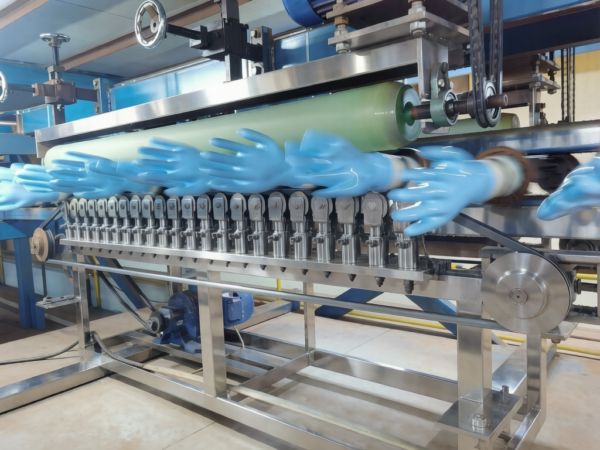
Fengwang glove beading machines are used in continuous production lines for nitrile, latex, and PVC gloves. Although the beading process may appear simple, it directly affects demolding efficiency and the appearance of the finished gloves. In a complete glove production line, automated beading equipment is positioned before the demolding station and after the drying station. It determines whether the glove cuffs are flat and uniform, as well as the yield rate and overall cost of the entire production line. The following sections elaborate on the core role of the beading machine in the production line and practical recommendations for cost reduction and efficiency improvement.
Core Functions of the Beading Machine
In a dual-mold production line, multiple beading machines are typically installed. When the hand molds on one line pass horizontally through the beading machine, the hand molds on the other line are raised to avoid interference, ensuring that the two lines alternately complete the beading process without disrupting each other. This design facilitates smooth subsequent demolding on dual-mold lines and improves the glove production line yield rate.
In addition to creating the necessary conditions for automated demolding, the beading machine also enhances the end-user experience. During the dipping and forming stage, the wrist cuff edge is flat or loose, and the demolding machine cannot accurately grip the cuff edge, which easily leads to defective products. After beading, the glove cuff forms a tight, curled structure that facilitates mechanical gripper engagement with the beaded area for glove stripping. Moreover, the tight glove cuff makes it easier for end users to put on the gloves, reducing the risk of tearing and slipping off.
Causes of High Beading Defect Rate
Insufficient contact between the hand mold and the beading roller, or single-sided beading, resulting in loose or missed beading.
Uneven force applied by the beading roller to the cuff, causing edge breakage or tearing of the gloves.
After gloves are torn on the rubber roller, rubber film debris falls and adheres to the roller, causing uneven beading and residual fragments.
Recommendations for Beading Process Optimization
1. Choose beading machines with adaptive spacing adjustment.
2. Incorporate beading machines into a preventive maintenance system rather than repairing after failures.
3. Flexibility and adaptability: If a production line needs to switch between gloves of different materials, the contact components of the beading machine (brushes/rubber rollers) and auxiliary heating modules should be replaceable or adjustable to facilitate switching between नाइट्राइल दस्ताने beading, latex glove beading, and PVC glove beading at any time.

 Hindi
 English
 Arabic
 Tamil
 Thai
 Malay