


To improve the yield rate and reduce the defect rate in nitrile glove manufacturing, a systematic approach is required—covering the entire production process, including process analysis, strict quality inspection procedures, and precise parameter control. Through this comprehensive strategy, the defect rate can be effectively maintained at a low level.
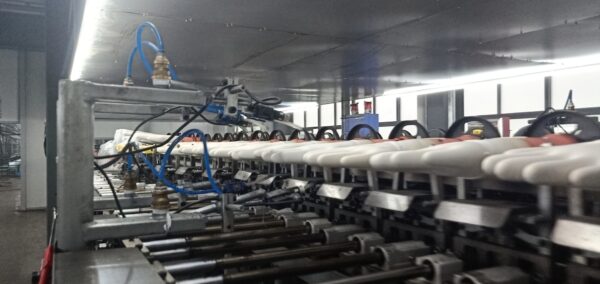
1. Source Control: Latex Compound and Formulation Management
First and foremost, raw material selection determines glove quality from the very source. Optimizing the ratios of chemical auxiliaries—such as vulcanizing agents and accelerators—can significantly enhance the physical properties and consistency of the gloves.
In addition, precise control of the latex compound condition is essential. For example, to prevent air bubbles from forming in the nitrile latex, it is recommended to use dipping equipment equipped with stirring and degassing functions. During production, the latex should be continuously stirred and circulated to prevent sedimentation and bubble formation.
2. Dipping Stage
Defects such as pinholes, bleed-through, or peeling can result from unsuitable mold temperatures at this stage. To prevent these issues, the glove molds should be preheated to 45°C–55°C before dipping in the coagulant. If the temperature is too low, the solvent in the coagulant will not evaporate quickly enough, leading to defective gloves.
3. Vulcanization and Drying Stage
Precise temperature control during vulcanization is a critical step. Temperatures that are either too high or too low can cause glove deterioration or tearing. A recommended approach is to adopt a stepwise vulcanization and drying process—starting with a lower temperature (e.g., 75°C) and then gradually increasing to a higher temperature (e.g., 110–120°C). This method ensures more complete curing and greater performance stability of the gloves.
4. Quality Inspection Stage
Production line conditions should be monitored continuously. Operators should regularly check glove color and tactile feel, and address any issues promptly. At the final quality inspection stage at the end of the production line, defective products should be intercepted within the workshop through the following methods:
Air inflation testing to detect leaks
Visual inspection under light to identify surface defects
Thickness and length measurement to verify dimensional compliance
Additionally, throughout the entire nitrile glove production process, detailed records should be kept for every production step, documenting any malfunctions and defect occurrences. Statistical analysis should be conducted to summarize recurring issues, enabling targeted improvements and corrective actions.

 English
  Arabic
  Hindi
Hindi  Tamil
Tamil  Thai
Thai  Malay
Malay